If You Would Understand What I’m Saying You Would Be Trans
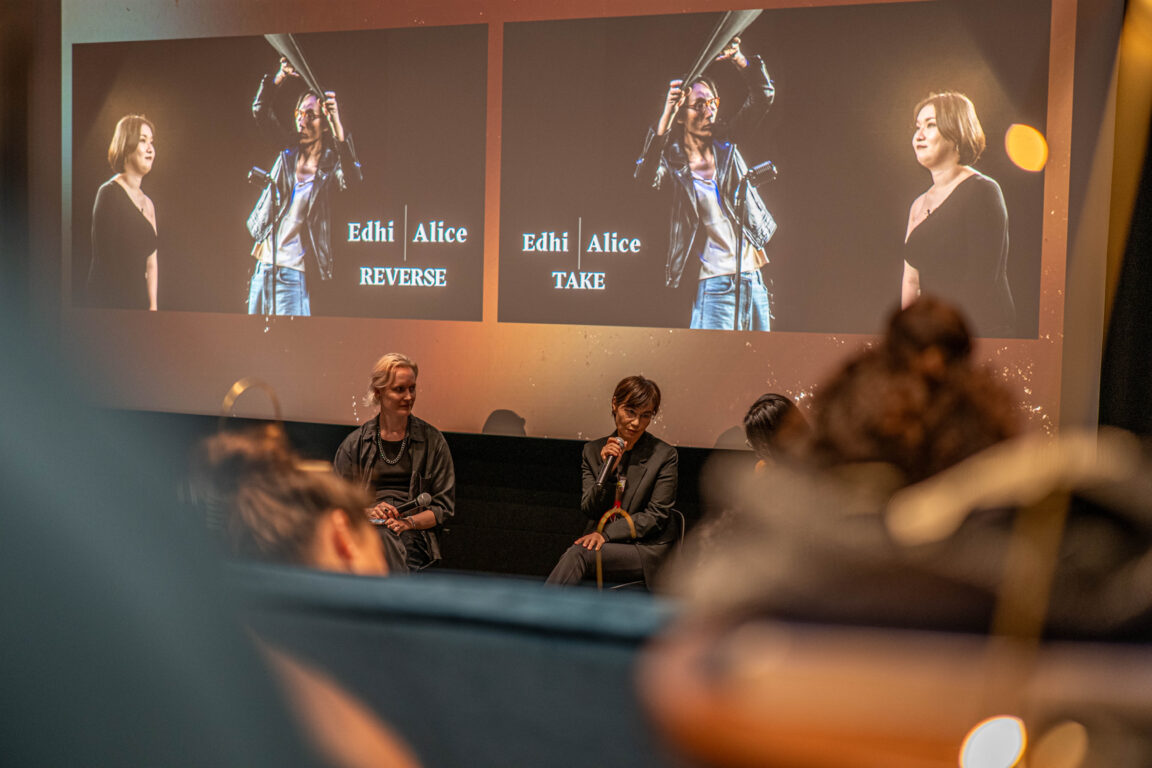
TransBorder Conversations is a screening and masterclass organized by Academy of Moving People & Images and Art School MAA and supported by the Finnish Film Foundation. Collaboratively, we commissioned an article on the latest event, held in Kino Konepaja, Helsinki, in September, 2025.
Text by Camille Auer
Photos by Samuel Boateng
This is a critical companion text to the masterclass and screening of the film Edhi Alice: Reverse. The masterclass by the South Korean director Ilrham Kim was organized by TransBorder Conversations and moderated by the Finnish writer and executive director of the House of Text, Mira Eskelinen. This text is a critical reflection of the film and was co-commissioned by Moving People and Images Journal and the Finnish Film Foundation.
I have to admit my knowledge of trans culture in South Korea is very limited, so I will write only about my experience of the film and, probably, inevitably, because of my own immersion in it, how it relates to western trans discourse.
In a scene happening inside a small apartment that appears to be partly below street level, one of the main characters of the film, Alice, is talking to her cat. She says: “if you would understand what I’m saying, you would be human.” The South Korean film by director Ilrham Kim follows two trans women, Edhi and Alice, in their daily life and tells a story of their transitions, shedding light to two particular transfeminine lives in Seoul.
In addition to the two main characters, the film features the making of the film itself. The film crew is often in the shots and the process of setting up shots is often what constitutes the dynamic of the shot. Another multitude of main characters are the locations of the film, the architecture of the city and the rooms in which the human characters operate, and the architecture of the film itself, how the shots are built and how the film is constructed in time, the temporal architecture of the edit.
The film folds over itself creating containers within containers. In addition to having the meta level of showing the process of making the film, the film also has another film within the film. Shots of film running through a film editing workstation and close-ups of film being cut and taped back together illustrate moments of voice-over narration. The equipment used by the film crew in the shots is entirely digital, so the inclusion of images of film remains a mystery until the very end of the film, when we see a beautiful abstract film during the end credits. This experimental film has undulating colours rippling and transforming, reflecting, appearing and disappearing.
 The abstract film at the end feels like another version of the whole film, one that only has the vibes and atmosphere of the film with none of the information. It has the end credits on top though, making it just a backdrop for, indeed, information about the film. Showing the actual materiality of film while also showing the digital equipment used draws attention to the different ontologies of these technologies— film is material; light physically draws forms in chemicals, while digital images are material in ways that are perhaps harder to grasp as physical, they are data that isn’t tied to a specific singular object like a roll of film. The data is also still material, stored on hard drives and data servers.
Edhi Alice has a surface level trans narrative that feels intrusive and superimposed on an otherwise beautiful and multilayered film. Interviews with the main characters concern transition tropes from how did you know you were trans to what kind of sex you had before transition. I wish we would be allowed to just see these women exist in the world and encounter it as themselves as who they are now.
The film moves between different spaces and layers, weaving a compelling image of two particular lives in a specific time and place. Alice is a professional film lighting director and Edhi works as a counselor for LGBTQI+ youth. Their personalities and presence are the two pillars that create the overarching, somewhat symmetrical structure of the film – the first half belongs to Alice, the second to Edhi. Their differences create a pleasant dissonance, Alice being rather timid and serious, which makes the warmth she emanates feel all the more special, Edhi being more bubbly, sassy, and bursting with joyful energy, contrasted with a sadness of how the world treats her and her sisters. Alice is a cat person, Edhi is a dog person.
The film introduces spaces for both main characters that I would describe as private, public, aspirational, and shared. The film begins showing Alice on a street, then at her home, her private space. Her apartment appears small and ascetic. She shares it with her cat. Her public spaces are the film studio, different film locations, and outdoor spaces between the different places. Her aspirational space is a dance studio; she thought dancing would be something she can never do, and throughout the film we see her taking the first steps towards finding a way towards dancing. Her dancing is beautiful in its own right, but perhaps also because it seemed like an impossibility to her.
The spaces are introduced pretty much in this order. The space the two women share is a women’s bathhouse. Edhi’s aspirational space is a gay men’s choir she joined as an effort to find community and ended up staying even after realising she was a woman, not a gay man. Her public space is also the film studio, but she’s only visiting there for her interviews. She is also shown doing her job, giving online counseling for queer youth. Edhi’s private space is an apartment she’s in the process of renovating with the help of her mother and outdoor spaces in the countryside where her dad lives. She dreams of a house in the countryside where she could live with her family.
The spaces are containers for the events of the film. There are containers within the spaces too. Alice points out baskets on top of the lockers in the dressing room of the bathhouse. The baskets seem to be full of hygiene products, which could be seen as technologies of feminine appearance. She is later seen in a huge warehouse, gathering boxes onto a hand-pushed forklift. The viewer isn’t given information about what the boxes contain, but the environment could be seen as very masculine. Maybe it’s lighting equipment. She takes the boxes outside and sits down, bent down and holding her head while her voice is heard over the image talking about getting fired from a film gig because of transphobia. She wonders who she is, what she likes, and what she hates.
I saw the director’s cut version of the film. The different spaces and scenes are like stones dropped in water, causing ripples that slip through other ripples made by other stones later in time but close enough for the ripples to intermingle. The film culminates in a scene in which the two trans women are in a women’s bathhouse. The scene is dispersed on both sides of the midway point of the film, it is the scene that brings the stories of the two women together and it seeps into both of their sides of the film.
The women have a very different relationship to the bathhouse. Alice says with solemn certainty that it’s the first and last time she will be there. The director asks why she thinks it would be the last time. She replies that the entrance would be too scary, the likelihood of being misgendered being too high for her to even try, and even if she did get in, she would be worried about the other women talking about her.
Alice is in the space as a lighting designer. When Edhi is first seen on the screen, she isn’t introduced, and I only later realised how clever that editing decision was. She is just a woman in the bath and Alice is setting up the lighting so a film crew can film her. Later it is revealed that the film Alice has been lighting all along is this film and the woman in the bath is the other main character.
The film grows from the midpoint towards both directions, end and beginning. The order of the scenes could be reversed, and apparently there is another version of the film where the sections of each woman are in the opposite order. I didn’t get a chance to see the other version.
The film puts unnecessary emphasis on genital surgery, which, needless to say, is another massive trans trope mostly focused on by curious cis people. The brilliance of the film’s structure, the beauty of its cinematography and the undeniable charisma of its main characters gets massively shot down by the tired old question of “have you had The Surgery”. Apparently having a sex reassignement surgery is a requirement for legal gender recognition in South Korea, which of course does make it more of a legal necessity and affects the cultural significance it has also for girls themselves.
The film follows Edhi to Thailand where she has The Surgery. Later the film shows multiple shots of her working on dilation. Also Alice is shown visiting a gynegologist to talk about dilation. She says she stopped doing it because she thinks she’s too old to date anymore so it doesn’t matter if her vagina will not stay open. She seems to be quietly giving up, while Edhi is holding on to hope. I guess vaginoplasty and the dilation that is required afterwards serve as a metaphor of opening up space and struggling to keep that space open. I wonder what the ethics of using such an intensely private thing as a metaphor are.
The film plays with reflections a lot. Alice’s face reflected on rippling water in the bathhouse, Edhi wiping a steamy mirror to see her face, streetlights reflected on wet asphalt while Alice walks through gentle snowfall, and the reflection of Alice’s phone on her glasses when she’s watching ballet on her phone. Reflections of light are, of course, also what images in a film concretely are. Alice’s work with lighting is what makes Edhi visible, and herself. I wish this trans gaze would be the dominant one in the film and not the cis one represented by the director’s intrusive questions.
Knowing the experience of someone else is something that art can facilitate. Recalling what Alice said to her cat in the beginning of the film, if you would understand what I’m saying you would be human— maybe this film will even make someone who’s not a trans woman from South Korea understand a tiny bit of what it is to be a trans woman in South Korea, or maybe it will just show a glimpse of the lives of two specific, beautiful, hurting, loving, flawed, and infinitely important women.
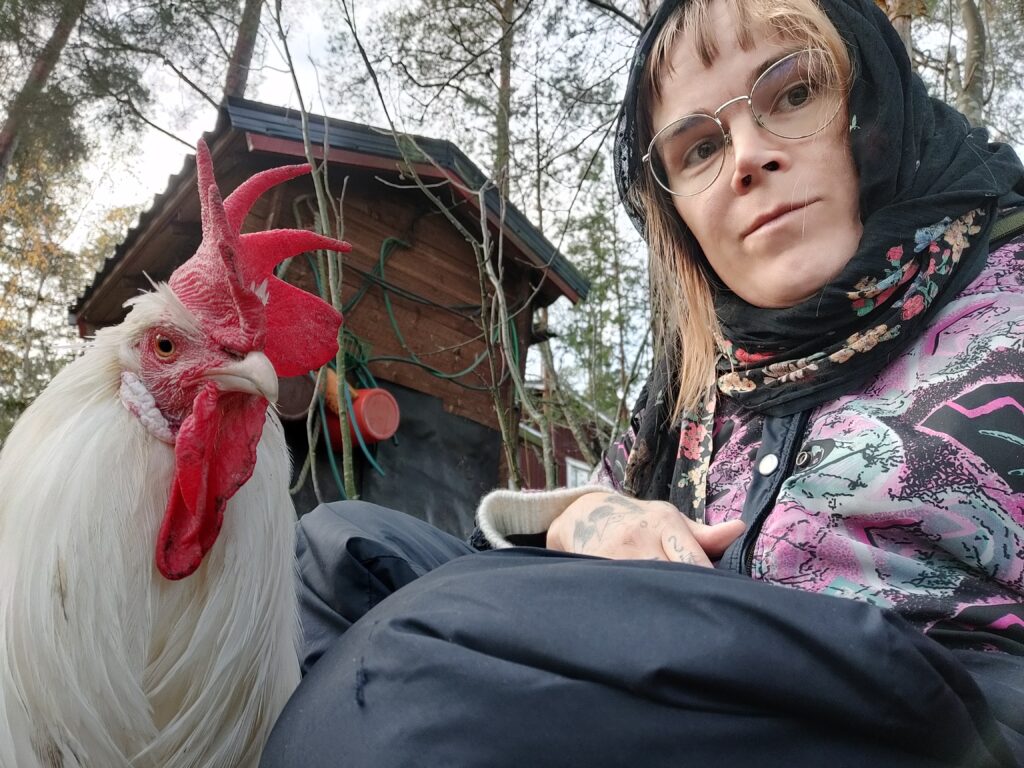 Camille Auer is a media/performance artist, writer and cultural critic from Turku, living in Helsinki for now. She loves the murkiness of hard facts and thinking about queer birds. Currently she wants to premeditate on what would it look like to let things unfold in an unpremeditated way. Camille has had eight solo exhibitions, participated in museum exhibitions and shown work internationally. She has an upcoming exhibition at Sinne gallery and is touring her performance Ruff Knowledge internationally.
The article is published in cooperation with Moving People & Images Journal.